Page
: 1
A la Bien-Aimée
:
 Poetry 2006-08-29 (7254 hits
) Poetry 2006-08-29 (7254 hits
)
A la femme aimée
: Etudes et préludes
Poetry 2006-08-21 (10478 hits
)
Bacchante triste
: Etudes et préludes
Poetry 2006-08-21 (9641 hits
)
Chair des choses
: Sillages
Poetry 2006-08-21 (8094 hits
)
Chanson
:
Poetry 2006-08-29 (7343 hits
)
Essentielle
:
Poetry 2006-08-29 (7056 hits
)
Fête d’Automne
:
Poetry 2006-08-29 (6787 hits
)
Je connais un étang
:
Poetry 2006-08-29 (6450 hits
)
Le Palais du Poète
:
Poetry 2006-08-29 (6403 hits
)
Le Poète
:
Poetry 2006-08-29 (6630 hits
)
Let the dead bury their dead
:
Poetry 2006-08-29 (7049 hits
)
Mon Paradis
:
Poetry 2006-08-29 (7094 hits
)
Ondine
:
Poetry 2006-08-30 (7733 hits
)
Petit Poème érotique
:
Poetry 2006-08-29 (8456 hits
)
Poème d’amour
:
Poetry 2006-08-30 (6758 hits
)
Roses du soir
: Evocations
Poetry 2006-08-21 (8310 hits
)
Ta royale jeunesse a la mélancolie
: Evocations
Poetry 2006-08-21 (8430 hits
)
Page
: 1 |
|

|
|
|
|
Biography
Renée Vivien
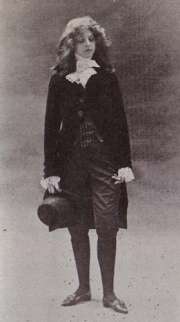
Renée Vivien, born Pauline Mary Tarn (11 June 1877 - 18 November 1909) was a British poet who wrote in the French language.[1][2] She took to heart all the mannerisms of Symbolism, as one of the last poets to claim allegiance to the school. Her compositions include sonnets, hendecasyllabic verse, and prose poetry.
Vivien was born in London, England to a wealthy British father and an American mother from Jackson, Michigan. She grew up in Paris and London. Upon inheriting her father's fortune at 21, she emigrated permanently to France.
In Paris, Vivien's dress and lifestyle were as notorious among the bohemian set as was her verse. She lived lavishly, as an open lesbian, and carried on a well-known affair with American heiress and writer Natalie Clifford Barney. She also harbored a lifelong obsession with her closest childhood friend and neighbor, Violet Shillito – a relationship that remained unconsummated. In 1900 Vivien abandoned this chaste love, when the great romance with Natalie Barney ensued. The following year Shillito died of typhoid fever, a tragedy from which Vivien, guilt-ridden, would never fully recover.
Vivien was cultivated and very well-traveled, especially for a woman of the late Victorian and Edwardian periods. She wintered in Egypt, visited China, and explored much of the Middle East, as well as Europe and America. Contemporaries considered her beautiful and elegant, with blonde hair, brown eyes flecked with gold, and a soft-spoken androgynous presence. Before the manifestations of illness, she was well-proportioned and fashionably slender. She wore expensive clothes and particularly loved Lalique jewelry.
Her Paris home was a luxurious ground-floor apartment at 23, avenue du Bois de Boulogne (now 23, avenue Foch) that opened onto a Japanese garden. She purchased antique furnishings from London and exotic objets d'art from the Far East. Fresh flowers were abundant, as were offerings of Lady Apples to a collection of shrines, statuettes, icons, and Buddhas.
|


 Recommended Reading